

I promise, you can take care of you.
If you’ve landed on this article, chances are, you may be struggling with some shame around how you show up in relationships.
Codependency, to me, has quite a lot of stigma baked right into the name — in a society that prizes independence, the idea of being dependent can imply weakness, dysfunction, or even being a burden.
But humans are meant to be interdependent. We’re not meant to do this alone.
Some of us will first encounter the idea of codependency in the context of addiction, as if we can be addicted to something like love, which we also fundamentally need and require as humans.
Still, learning about codependency — and trauma responses like fawning — has helped me begin to work on patterns in my relationships that don’t feel great, and cultivate more interdependence (where we are responsible to one another without being responsible for one another).
The best framing I’ve found of codependency that feels the least stigmatizing is a relationship in which our loved one becomes a substitute for any and all coping tools, creating a dynamic in which a person can only feel regulated and okay when the other person is.
It’s essentially like saying: “I’m not okay if you’re not okay.”
But as I’ve learned in my own journey, it’s possible to be grounded even when someone you love is struggling, and it’s also possible to struggle while still holding yourself through it in a grounded way.
Not perfectly and not all the time, of course, but in a way that ensures no one is running on empty.
And this can sound quite alien to us if we’ve only ever related to people we love in this way!
Without being anchored within ourselves, though, we can find ourselves in all sorts of relationships — not only with partners, but with friends and family — that feed into a rescuing or savior dynamic.
And in these dynamics, we may isolate ourselves — or as a therapist once described it to me, put all our eggs into one relational basket. If we assume the caretaking role, we may no longer find it tolerable to let the people we love have their own emotions and struggles.
I’ve ping-ponged between both roles, and what I’ve found is that, when we’re triggering one another, we’re no longer present with the person we’re in a relationship with.
Instead, we’re in crisis management mode, where we’re projecting onto the future what we fear might happen, instead of being present with this person we love.
Whether we’re so afraid of burdening someone that they leave us, or we’re afraid we won’t do a good enough job caretaking that the person will collapse or fall apart, the dynamic doesn’t allow either person to be in the present moment.
For the caretaker, we may start to feel like the relationship is a job instead of a reciprocal and supportive connection; for the person receiving care, we can become so subsumed by insecurity and shame, we begin living as if the other shoe will drop in that relationship at any moment.
If this is familiar to you, I want you to know that you have nothing to be ashamed of.
It makes perfect sense, given how many of us survive trauma and neglect, that we adapted by either being the caretaker for others in order to feel useful and therefore lovable, or to attach strongly to someone who could meet our needs.
That doesn’t mean, of course, that these dynamics aren’t harmful to the people in them, and that we aren’t accountable for our impact on others. But it does mean that our past selves, who may not have known better, deserve some grace.
I know that the idea of “self-care” has become quite fluffy in recent years, but self-care was actually central to how I slowly began to cultivate a sense of self-efficacy and, in time, shift away from codependency.
Self-care is less about changing how I feel or even regulating myself, but instead, cultivating a practice of spending intentional time with myself.
And this is hard for folks on both sides, frankly!
If you’re rescuing as a source of self-worth and connection, it can be hard to take time for yourself. And if you’re struggling to be alone without another person to co-regulate with, self-care can be a way of dipping your toes into other types of self-soothing.
Wherever on this spectrum you fall, I would deeply encourage you to see self-care not as a way of “fixing” codependency, but instead, a way of coming back into contact with yourself.
That said, self-care can be especially hard if you’re someone whose pattern is codependency. You might consider, then, the idea of “micro-dosing” self-care, where you practice it — with very small bites of new activities and practices — to see how things feel for you.
While I don’t believe that any of us are meant to survive the world alone, being able to have a flourishing relationship with yourself — where time spent alone is a gift, and not a trigger or an afterthought — can feel so empowering.
I promise, you can take care of you, too. It may take time, but the relationship you have with yourself is one worth nurturing.
To that end, these are a few of my suggestions for cultivating such a practice.
1. Build Up Your Support System
I used to think that the best way to unlearn codependency would be to go on some solo travel journey or silent meditation retreat.
I guess I thought if I forced myself to be alone and disconnected for a prolonged period of time, I would adjust, and eventually realize the magic of being independent, I guess?
I laugh about that now, because if it were truly that simple, wouldn’t we have just done that already?
Instead, rather than taking a restrictive approach, I prefer to think of this as an additive process.
So, if you find yourself being enmeshed with one person in particular, it’s a good challenge to shift your focus and look for opportunities to connect with others.
That can be a therapist or trauma-informed coach, of course (which I highly, highly recommend — shoutout Alexis, my own incredible coach of many years), but there are tons of online communities, neurodivergent-friendly dating apps, and local meet-ups worth trying.
And no, you don’t have to be a healed or perfect person to seek out new relationships. But if you’re worried about your readiness for new people, I’d try out therapy or coaching and support groups first.
I’m going to call you (and me!) out a little here, too: A lot of us need to reconnect with the friends we used to have and might have even ghosted when our codependent relationship ramped up in intensity.
The goal is never to be completely isolated, but instead, to let yourself be held by a community of people.
Reaching out is absolutely a crucial form of self-care.
2. Pick Up a Book (Or Four!)
There are four books that have essentially become my compass for navigating relationships, especially as someone who struggles with people-pleasing and fawning.
I recognize that not everyone has the capacity to read that much, so I’ll offer a little guidance on each.
- The Art of Showing Up: How to Be There for Yourself and Your People (Rachel Wilkerson Miller): This is essentially an overview on how to be good to yourself and others, with a lot of tangible advice, practices, and skills. If you’re more action-oriented, this book is your map and you’ll likely enjoy it!
- Slow Pleasure: Explore Your Pleasure Spectrum (Euphemia Russell): If you’ve been curious about all this nervous system stuff therapists talk about on Instagram, or you just don’t know how to be in your body, this book helps you get acquainted with yourself so you can move from a more embodied and grounded place.
- Set Boundaries, Find Peace: A Guide to Reclaiming Yourself (Nedra Glover Tawwab): If you don’t know how to say no or hear no — or if you have no idea what boundaries even are but you’ve been told you probably need better ones — this book is an actionable and essential read.
- Stop People Pleasing: And Find Your Power (Hailey Magee): If you’re the rescuer or caregiver, or someone who deeply struggles to feel secure in relationships, this is by far one of the best reads I’ve found that examines people-pleasing from not only a relational lens, but a trauma-informed and systemic one.
And since I know these reads can be heavy, I would highly encourage taking a more gentle approach.
Reading a few pages here and there is totally valid! Audiobooks are a great option that also make you feel like you’re hanging out with the author. Highlighting sentences and writing in the margins can make it a more active and engaging process if you tend to get distracted.
3. Have a Crisis Plan That’s as Accessible as Your Default
If you know that your default is to rapid fire text the person you love when you’re feeling flooded, it’s so important that you find an “SOS” option that is just as accessible as the thing you’re reflexively reaching for.
Remember, we’re not trying to restrict connection or punish yourself into behaving differently. Rather, we’re giving you more accessible options so you can make a choice about what support makes sense in the moment.
There are two resources I really love to offer that I find to be as accessible as the Panic Text:
Self-Care Flow Chart
I love this interactive quiz because it feels conversational without expecting too much of me. It’s like having a friend or partner there to walk you through what you need to do to reset, except it requires no one but yourself to actually use.
Finch Self-Care App
This is basically like… Neopets meets Tamagotchi, and you get rewarded for practicing self-care! Not only does the app have preset coping tools to try, including things like chair yoga and breathing exercise, you can also connect with your friends through the app — which is lovely, because they can send you gifts, hugs, and other types of interaction without a heavy conversation.
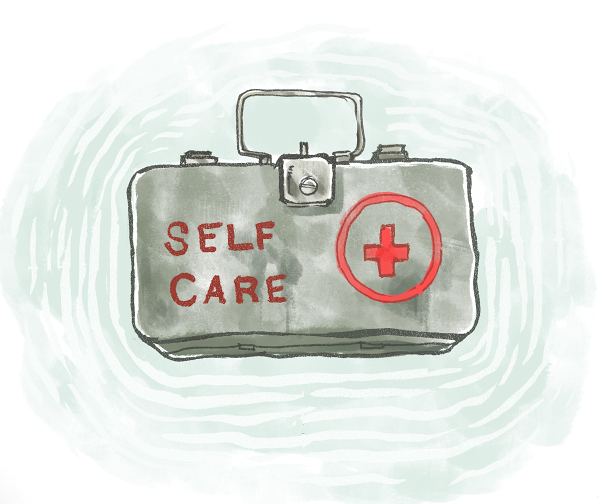
4. Create a Self-Care Kit
I encourage anyone, regardless of what they might be struggling with, to get an old box or container of some kind and put together a “feel good” kit for those inevitable cruddy days.
Some suggestions on what you could include:
- A bottle of your favorite scented lotion or bath product to lather up with
- Your old iPod or music player so you can dance without being tethered to your phone
- A favorite movie with a bag of microwavable popcorn
- A stuffed animal to cuddle with when it gets rough
- A book that makes you laugh when you read it
- A box of tissues for when you’re crying
- A favorite fidget or toy that helps you self-soothe
- A super soft pair of socks that make you feel cozy
- A candle or incense you could light
- A crisis hotline number just in case
- A list of phone numbers for three other friends, partners, or family members that you can call
You don’t have to go out and buy these things! They can be items you already have on hand, or you can ask if any friends have items they might donate.
The idea is that if you keep these things in one place, they’ll be easy to access and you’ll be more likely to use them.
5. Start a Journaling Practice (And Notice Your Patterns!)
I know it can be annoying when you’re told to start journaling, especially because journaling can be hard for those of us who are perfectionists and have a hard time knowing where to start.
Even as a writer, I found journaling to be so intimidating.
I recently began using Wilde House Paper’s “Open Journal,” which not only is just a really lovely, high quality journal, but it actually comes with a QR code that unlocks several courses that teach you how to journal with video guides, prompts, and other inspiring resources.
I think journaling is so important for those of us who struggle with codependency, because without a regular check-in with our own thoughts and emotions, it can be easy to get swept up in somebody else’s.
It can be hard to come back to ourselves and figure out what’s going on! And with codependency being a conditioned sort of pattern, if we aren’t paying attention, it can really sneak up on us.
Journaling is such a wonderful act of self-care, and this journal in particular has made it feel so much more approachable. I find myself falling in love with the practice more and more each day.
Remember: Unlearning codependency is a process, not a destination.
Codependency doesn’t just happen at random. For most, if not all of us, it was a survival strategy in the face of neglect or trauma.
It’s so important, then, to be compassionate with yourself, and know that this is a process — of learning how to connect more deeply with ourselves, in order to stay present in our relationships — rather than a finish line you sprint towards.
It’s a tremendous thing just to be self-aware of a pattern in your life, and to commit to supporting yourself in new ways! So many people don’t get that far.
Be proud of these small steps you’re taking. They matter, even if sometimes it feels like a crawl more than a confident walk.
—
☑️ Up-to-date! This checkmark means that this content has been reviewed and updated for our relaunch in January 2025. Some reader comments may therefore be out of context.
Photo by Helena Lopes on Unsplash



Leave a Reply