

Self-help articles are great. In this day and age, the internet is one of the largest sources of self-help content — and as someone who loves to uplift others and be uplifted, this is a genre that I have a strong affinity for.
But I’ve noticed this really unfortunate trend as of late – namely, articles that suggest that in order to be happier, we need to avoid the habits of “chronically unhappy people,” or remove “negative people” from our lives altogether.
Is someone bringing you down? Just get rid of them! Don’t want to be a downer? Fix yourself!
This all seems to be code for, “depressed people are shitty, and here’s how to avoid them and avoid being like them.”
This is basically saying that folks who are suffering from depression – because that’s what it means, right, let’s call a spade a spade – are not worthy of our patience, love, and support.
Further, we should aspire to be the exact opposite of them, as there is nothing redeeming about them. Let’s observe their struggles, and from that extract all the “what not to do’s.” I think that’s a really problematic response to have to someone who has depression.
When we treat people with depression as though they’re a burden or plague, it perpetuates the stigma that comes with depression, and encourages people to ostracize those who suffer from depression.
Further, mainstream self-help articles push this dichotomy of happy versus unhappy people, oversimplifying the complexities of real people. Moods, and even mood disorders, do not define the entirety of a person.
If it were just one article, I wouldn’t be as concerned. But there are many articles that continually make these vague, and sometimes not so vague, references to people who very well may suffer from depression – treating them as undesirable, broken, and negative forces that need to be eliminated from our lives. They are dehumanized and reduced to their illness, rather than seen as whole, worthwhile, complete people.
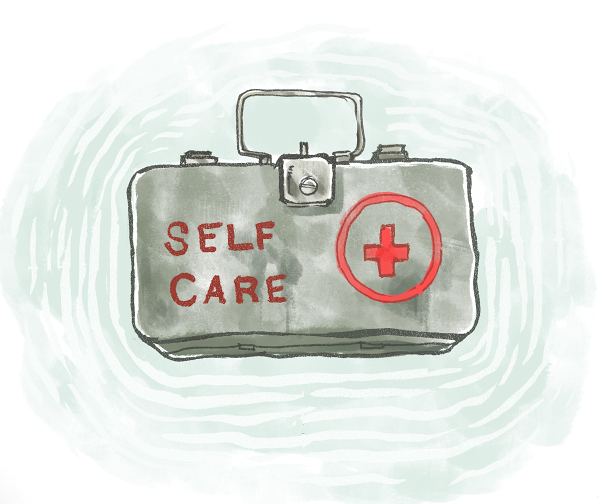
If someone in your life is depressed or going through a difficult time, it can be tempting to run for the hills. And of course, I’ll never undermine the importance of self-care. We are responsible to our friends, but never for our friends. But there’s a consistent problem in our society with ignoring depression when we see it, or worse yet, expecting folks with this struggle to fix it themselves, and not “burden” others with what they’re going through.
This creates a culture that is particularly hostile to those with mental illnesses. Criticizing them for feeling victimized, for being unhappy, and for not meeting your criteria for “trying hard enough” or “problem-solving,” all uphold awful stereotypes about the disorder and about people who suffer from it.
Personally, I’d like to create a culture in which folks who are unhappy can find support — and that we don’t ignore or opt out the moment we realize they might not be all sunshine and rainbows.
There’s also this terrible habit in self-help to look down on this idea of “victimhood,” without being critical of where those perspectives come from. If someone is conditioned to expect that their life will be difficult, perhaps it’s not an issue with attitude, and maybe, just maybe, a problem with the culture and society at large. If someone expects that their life will be difficult, maybe that isn’t an attitude problem and instead, their lived reality.
I suspect that if you’re looking down on folks who see life as primarily a struggle, you might be some combination of white, able-bodied, heterosexual, cisgender, middle or upper class, and more generally not feeling the full gravity of systematic oppression. When we write these articles, we need to ensure we are being intersectional, and being mindful of our privilege. Invalidating victims is not self-help — it’s oppressive.
The self-help genre could benefit from taking into account that diverse life experiences condition us to form different expectations and attitudes – ones that you may not have experienced before. Instead of placing the blame on the victim, maybe we should be pointing at the system that victimizes us every day.
The reality is, depression is hard. Mental illness is hard. And it’s not something that can be fixed over night with an attitude change. We’ve been saying this for decades – this isn’t our fault, and if we could make it better, don’t you think we would’ve already done that?
Yet, at times, self-help as a genre has been completely out of touch with the lived experiences of those with mental illness, as well as other marginalized groups, like folks of color and those in poverty.
There are certainly unhealthy habits that we could all afford to kick, but placing this in the framework of chronic unhappiness and depression is the wrong way to go. It does a huge disservice to people who are genuinely doing their best to cope with these illnesses. It creates bigger obstacles for people whose lives are devastated by depression.
There are better ways to offer advice and perspective in ways that aren’t ableist, and don’t kick folks while they’re down. Regardless of our good intentions, we must consider the impact of our work when it reaches a broader audience of people.
Perhaps most importantly, people with depression do not exist to teach you life lessons. And if you have someone in your life who is “chronically unhappy,” instead of taking notes for your next article like you’re on some mentally ill safari, maybe reaching out to them and checking in is the more appropriate response.
Self-help is a genre with a lot of potential to do good in the world. But if it only seeks to empower some while upholding the struggles of others, it is doing more harm than good. There needs to be accountability to our audiences, starting with those who are struggling the most.
Creating a greater stigma around depression, rather than dismantling that stigma, is the exact opposite of what self-help should be doing.
This genre could really benefit from a reality check. And maybe, just maybe, it could start by realizing that there are better ways to approach the “chronically unhappy” and depressed – starting with a little compassion.





Leave a Reply