
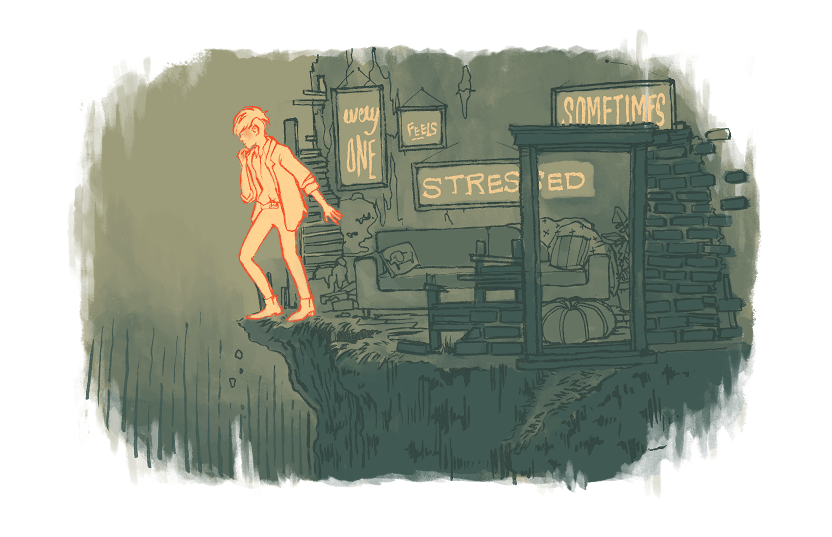
[The illustration features a house, seemingly unstable, perched precariously upon a cliff. The author, Sam Dylan Finch, is standing at the edge of that cliff, looking down with uncertainty. Inside the house, there are words in frames that read, “Everyone feels stressed sometimes.”]
I know this is an unexpected entry, seeing as I usually blog once a week. But it feels like the right time to talk about this.
One of the scary parts of bipolar disorder is that it often begets company. Co-occurring disorders are not uncommon for people who have bipolar, and yet they are conversations we tend to have behind closed doors. There’s something about having multiple labels assigned to us that really terrifies us.
Or at least, it really terrified me. I’ve been very open about my experiences with bipolar disorder, and have even discussed my history of disordered eating, yet I’ve never talked about my anxiety publicly, despite it being a disorder that has disrupted my life in undeniable and painful ways.
Not long after a diagnosis of bipolar disorder, I was given a second diagnosis of generalized anxiety disorder (GAD). And I promptly told no one.
The stigma associated with one disorder was already overwhelming. But a second disorder? It hardly seemed fair.
I was afraid of the judgment that came with not one disorder, but two, as so many people with co-occurring anxiety disorders feel.
While people were comfortable thinking of me as having bipolar after years of advocacy surrounding it, what would they think if they knew about my anxiety? I was afraid that I would be less respected as a survivor and advocate, and instead, be seen as “too crazy.”
I’m not alone in that, either. Sometimes when we talk about mental health, we feel pressured to be selective about what we share, or pick and choose how much we disclose. It’s like we’re allowed to be a little unstable, but we can’t be unstable to the point of being unapproachable. It’s a sort of respectability politics that many neuroatypical folks are constantly navigating.
Yes, even me. I was afraid at first to talk about my anxiety. Even the person who went viral for talking about co-occurring disorders.
And that kind of juggling act? Crazy-but-not-too-crazy? It takes a lot of energy.
GAD is not the easiest thing to put up on a shelf, and it became difficult to hide. As someone who has suffered from panic attacks and debilitating anxiety for as long as I could remember, it has been a consistent obstacle that has only worsened as I reached adulthood.
My tendency to lock myself in and frequently cancel plans, for example, did not go unnoticed by friends. Take the bus? To your house? But that’s a bus route I’ve never taken! And I could get lost! And what then?
Simple things were daunting – visiting a new place, taking the bus, even going outside – and in order to soothe my anxiety, I had a system of complicated rules that eventually descended into dysfunction.
Never take a new bus route without practicing it first.
Never take the bus after nine o’clock pm.
Never take the bus without a friend.
Never take the bus.
Never leave the house.
The “what then” and “what if” scenarios were never very likely, but felt real and threatening enough to discourage me from doing what I wanted and often needed to do. I was intimidated by seemingly simple things, stressed to the point where I eventually decided to do nothing at all. I would self-isolate or make excuses to avoid the things that scared me.
After one too many unexplained disappearances, cancellations, and panic attacks while I hid in public restrooms, I had to fess up: my bipolar had a companion, and that companion was called GAD.
If I had to describe generalized anxiety, I would describe it as chronic fear.
Fear of public transit. Fear of strangers. Fear of disappointing others. Fear of making mistakes. Fear of being abandoned. Fear of failure. Fear of mold. Fear of bugs. Fear of judgment. Fear of big crowds. Fear of being alone. Fear of talking too much. Fear of not saying enough. Fear of being disliked. Fear of the future. Fear of natural disasters. Fear of the “what ifs” and all the things that could go wrong.
And fear of absolutely nothing, fear for fear’s sake, fear of just being alive in a world that was inexplicably scary to me.
My life, on paper, could be going perfectly well. And yet I would still find something to be anxious about. My brain was incredibly skilled that way.
It was the kind of fear that gave me aches and pains, exhaustion, and nausea for weeks on end. The kind of anxiety that makes it impossible to eat or sleep, further draining my body and weakening my defenses.
There was a continuous dread that I felt in the pit of my stomach – the unwavering conviction that something terrible was going to happen, and I would be helpless to stop it.
I spent years at a time in a panic that I could not control or affect.
And when it reached a peak, I would have awful panic attacks – hyperventilating in a car, my hands going numb, my heart palpitating wildly in my chest, tunnel vision, unable to speak, cold chills sweeping over my body, unable to breathe and gasping for air that never seemed to reach my lungs.
I felt constantly on-edge, as if I were at the top of a roller coaster that was suspended, prepared to drop at any moment. And yes, in case you were wondering, I’m also afraid of roller coasters.
Bipolar and anxiety were a toxic combination that, alone, I could not overcome.
It took years of therapy, self-care, and medication before I began to make a dent in my anxiety. It has taken time, and to this day, it is something I’m still in the process of overcoming. And like everyone else that lives with chronic anxiety, I have my good days and my bad days.
Co-occurring anxiety disorders, and anxiety disorders in general, are not rare. But the stigma surrounding these disorders is all too common.
We are often faced with invalidation (“everyone feels stressed!”), disbelief (“I’m pretty sure that’s not a real disorder”), or worse yet, misguided advice that seems to suggest that we can simply “think” our way out of anxiety. All of these responses misconstrue chronic anxiety as something it isn’t – in our control and of our own choosing.
The reality is, people with anxiety disorders can’t just “fix” themselves. It’s an uphill battle, and one that warrants compassion, patience, and understanding.
As a mental health blogger, it would be against everything that I stand for to allow the stigma around anxiety disorders to discourage me from sharing my experiences. So I offer you this glimpse into my struggles with GAD with the hopes of creating a safer space for us all to talk about it — not just now, but in the future, too.
Yes, bipolar disorder and generalized anxiety too often go hand-in-hand.
But no, I’m no longer ashamed to say that this is what I’m up against.





Leave a Reply